Showing posts with label Canada. Show all posts

14 April 2009

Somewhat Muddled Thoughts on Media, the Olympics and the Vancouver Gang War

Right, so this little piece in the UK's Independent has been getting quite a bit of attention lately. Every single piece that cites the British article simply can't resist quoting this gem of pulp-fiction style sensationalism:
As it prepares to host the 2010 Winter Olympics, what it's got now is not cuddly, eco-friendly publicity, but blood-spattered streets littered with shell casings and corpses.

Vancouver is the battlefield in a war between myriad drug gangs, which include Hell's Angels, Big Circle Boys, United Nations, Red Scorpions, Independent Soldiers and the 14K Triad. Guns – often machineguns – are fired almost daily.
It sure is catchy, huh? And it's getting around. I just did a Google search with the terms "blood spattered streets littered with shell casings and corpses" and "Vancouver" and came up with 585 results.

Naturally, the media response has been all about how much this hurts our reputation as an Olympic city, and how reporting such as this will affect tourism revenue in 2010. Nobody is talking about the rest of the article, which is actually a reasonably balanced discussion of the problems underlying the gang war (drugs!) and possible ways of dealing with the violence, which run the gamut from better-coordinated law enforcement to (gasp!) marijuana decriminalization.

Of course, none of that sensible discussion is actually going to get noticed if you stick it way down at the bottom of an article with the headline "From heaven to hell: 18 die as drugs war rages on streets of Vancouver". For fuck's sake, it reads like copy from a bad mob film.

Now, I live in Vancouver, and I have yet to notice much of anything "raging" on my streets* and I have yet to trip over a shell casing or get blood all over my shoes on my way to work or school. Of course, there was a gang-related shooting within a few blocks of my house two years ago...

but then, I live in one of those "seedy neighbourhoods" that all of this nastiness has finally spread beyond. I've never harboured any illusions that Vancouver wasn't a city like any other--crammed with people and subject to all the problems, including violence and organized crime, that come with urban living and poverty--even if I've always thought of it as a wonderful place to live. There's a part of me that's really fucking pissed off about the way that so much of the discussion around the recent violence has been about how it's affecting nicer parts of town--how the wrong people (read: the rich) are being put in danger.

See also: most public discussion of the recent murder in Pacific Spirit Park, which was a horrible event that people are right to be upset about **, that consistently carries the tone of "but how could this happen in such a nice neighbourhood/to somebody like us" or else "this used to be such a nice neighbourhood until all those homeless people started moving into the woods". It took the deaths of dozens of women on the Downtown Eastside to generate this much public outrage. Such things are expected, but not what happened out in Point Grey.

And part of me is glad that our city's lovely reputation is being tarnished. Is glad that people are starting to think about these things as city-wide problems. Is fucking glad that we probably won't be able to glide by on that stupid "Best City to Live In" ranking for much longer. Because this city of ours--fucking beautiful and valuable in so many ways--has problems. Big problems. Problems with homelessness (which is a complicated mess of poverty, marginalization of people with drug and other addictions, affordable housing shortages and a climate that encourages migration of people from other cities in Canada where you can't live on the streets in winter because you'll freeze to death), with gang violence, with an enormous drug trade and a million other things that affect a city of this size with our particular collection of geographic and social conditions. None of these problems are unique to Vancouver, but that doesn't make them any less ours.

We have to own our problems, as a complete city, without dumping them on law-enforcement or dismissing them as side-effects of poverty (most of them are: that doesn't mean it's right, or that they and the poverty that causes them should continue to exist). We need to get the fuck over our image and fix what's broken.

I'd love for this to be a wake-up call.

Of course, reputation damage control is already being done, and the odds are that this'll just get drowned out by more feel-good propaganda to ensure the Olympics succeed. And in a way, I can see the logic to that. It's easier, for one thing, and for another, the painful truth is that we need the Olympics to succeed if we want our city to make it through this recession. We're already looking at a cost overrun into the billions of dollars, and we need every tourist penny to recoup what we can. It'll still end in a loss, but the less successful this event and the more money we lose, the more the poorest and neediest segments of our city will suffer as the programs they depend on are cut (and they're always cut first) to help offset the new tax burden.

I did not vote for the Olympics, I wish that we weren't hosting them, but I still want them to succeed as much as possible because the alternative would be so much worse for all of us. I won't cheer their failure because I know there will be a human cost, and it won't be hitting the nice folk in Point Grey and West Van who voted for the fuckers in the first place. And so a part of me thinks, "tell the tourists what they need to hear to feel safe (maybe the truth--that it's a city like any other and not a magical eco-wonderland that looks and feels exactly like a postcard), and to come here and help pay off our stupid Olympic debt."

And yet, I still hold out hope that this recent media storm has helped more people to see the cracks in our precious image, and has pushed them to seek out and repair the larger cracks in our city's foundations, instead of just plastering over what's visible and going back to admiring how pretty it all looks on the outside.

----


* Except for the asshole in the next building who beat up his partner and had to get hauled away by the cops a few nights ago, but that had nothing to do with the gang war and everything to do with individual nastiness and domestic violence. Whoever you were, fuck you.

** And really, that should go without saying in each and every case where a human being dies violently, or quietly from hunger and exposure, or in any way that is not how they wished to go.

11 April 2009

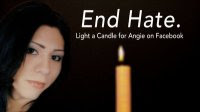
Light a Candle for Angie Zapata

Angie Zapata, an 18-year old Colorado woman, was murdered last July. The man accused of her murder, Allen Andrade, claims that he became "enraged" when he discovered that Angie was transgendered, and subsequently beat her to death. In other words, Angie was murdered for being trans.

Andrade goes to trial this Tuesday, April 14th and is being charged with a hate crime under Colorado state law, which added sexual orientation and transgender status as protected categories under its hate-crime legislation in 2005. This is the first time that the murder of a trans* person is being tried as a hate crime under this legislation, and discrimination based on gender identity has yet to be addressed by US federal law.

Angie's family, in conjunction with 50 civil-rights groups, has started an awareness raising campaign both in local papers and online to raise awareness of the effects of transphobia and promote acceptance of trans* individuals, and to increase pressure on US policy-makers to expand hate-crimes legislation to include gender-identity based violence and discrimination. One aspect of the project is an online candlelight vigil through Facebook, which is something that everyone can (and should) participate in. I've lit my candle.

The below video, found via Feministe and produced as part of the larger education campaign, shows her family talking about what Angie meant to them and calling for an end to discrimination. It's powerful, and a beautiful testament to the love and support she had in her life:


Please light a candle, re-post the video and links, talk about trans* issues with your peers, and help to raise awareness and put pressure on the government to help protect an incredibly vulnerable group of people.

----

This campaign made me curious about the degree of protection that trans* people receive under law up here in Canada, and I discovered it's muddier and less comprehensive than it should be. From what I've read, there is no explicit protection for anyone under "gender expression" in the Charter of Rights and Freedoms (which is our federal human rights legislation). However, provincial Human Rights Commissions in British Columbia, Alberta and Saskatchewan have ruled that gender expression is included under the definition of "sex", which is a protected category. Both Ontario and the Northwest Territories explicitly define "gender expression" as covered, while the situation is unclear in Manitoba, which lists "gender based characteristics" under the "sex" portion of its human rights code.

The Canadian Human Rights Commission (CHRC) doesn't list gender identity in its definitition of "sex", nor does the Criminal Code include trans* individuals under its definition of an "identifiable group" that is in danger of being targeted with a hate crime. Though the CHRC has acknowledged that
There is a significant body of human rights jurisprudence that has found that discrimination on the basis of transsexualism constitutes sex discrimination.
and has indicated (see note under "1996") that it will hear complaints from trans* people of discrimination on the basis of sex, the fact that this is not explicitly laid out in the federal Human Rights act and the lack of hate-crime provision in the Criminal Code leaves trans* people in a weird sort of semi-protected limbo.

There is still much work to be done at home as well as across the border to ensure that all of us are granted the equality and protection we need under law.

Light a candle.

16 October 2008

Election Post-Mortem

Damn. I can't say I'm surprised that Harper got another minority, but I definitely am disappointed. I have a few (somewhat disjointed) thoughts about the election results:

On the one hand this really is a victory for the Conservatives. The timing of the election (although calling it early broke that pesky law that the Cons themselves had pushed through) could not have been better: the looming financial crisis in the US turned the economy into the single biggest issue, which certainly worked in Harper's favour. It's not so much that the Conservatives are unarguably better on the economy than the other parties (in fact, I think they are worse, but it's at least somewhat debatable), but that they are not unarguably the worst the way they are with other issues, such as the environment, women's rights and the arts. And they did win another minority government, which allows them to appear more moderate than they are while at the same time sneaking in little nasties like Bill C-484, which would grant an unborn fetus legal status--something that could have serious ramifications for abortion rights in Canada. If they play their cards right and continue to gain seats as they did in this election, we could be looking at a Conservative majority within the decade.

On the other hand, it may prove to be an illusive, or at least temporary victory. For starters, I doubt I'm the only person to question the wisdom of breaking the law in order to call a costly election ($290 million taxpayer dollars--in these oh so uncertain economic times, natch) that did not result in a majority--or even a particularly significant shift in the status quo. In fact, some conservatives (to say nothing of the opposition) are already calling it a waste:

"I think we'll have wasted our money if we don't get a majority," Conservative supporter Jan Sproule said as she watched the results.

(from BC's Province newspaper, which is a bit of a rag but is also, I suspect, just the first of many to be making comments of this type).

I won't be surprised in the least if the election's failure to accomplish much of anything will become a bit of an issue in the weeks and months to come. The fact that we are still looking at a minority government also gives me some small amount of hope. While it may help make him look more moderate and potentially gain more votes down the line, Harper's need for cooperation from the other parties (all of which sit to the left of him on the political spectrum) to make this government work--especially now that he failed to win a majority for the second time in a row, which is not exactly a show of voters' unfailing trust in the Conservative party--means that he will have to compromise on issues where he faces the most opposition from those parties. Issues like, oh, the environment. Or the arts. Once again, that fine Canadian art of compromise may actually make this end in everyone's favour (or at least make sure that no one group gets stomped too hard).

Political implications of the results aside, I think this election also demonstrates clearly (and, yet again), the shortcomings of our first-past-the-post electoral system, where whoever wins in a riding (by any margin) gets a seat in parliament, and the actual amount of votes they won is essentially irrelevant. All it takes is a quick look at the numbers:

Parties Ranked by # of Seats won (i.e. rank determined by our current system):

1. Conservatives (143 seats)
2. Liberals (76 seats)
3. Bloc Quebecois* (50 seats)
4. NDP (37 seats)
5. Independent (2 seats)
6. Green Party (0 seats) = "Other" (0 seats)

Parties Ranked by % of Popular Vote (i.e. how it would have played out under a system of Proportional Representation):

1. Conservatives (37.63%)
2. Liberals (26.24%)
3. NDP (18.20%)
4. Bloc Quebecois (9.97%)
5. Green Party (6.80%)
6. Independent (0.65%) ~ "Other" (0.51%)


When you're dealing with the winners in an election (i.e. the top two spots, reserved for the ruling party and official opposition), there's little variation between the two sets of results, except that the second list shows a smaller gap between the two parties in terms of support. Where things get really interesting is with the lower half of the list. Take, say, the NDP and the Bloc: although the NDP won almost twice the number of votes that the Bloc did, it ends up with less seats (and thus less power in parliament) under our current system. Likewise, the Green Party, which got a solid 6.8% of the vote gets no seats at all (and so about 2.2 million people get zero representation**). I don't think either of those results is particularly fair, or directly reflective of the wishes of Canadians.

It's time for a change in how we elect our governments.


---

* The PQ is a bit of an oddity here, in that it only runs candidates in the province of Quebec. I find it fascinating that a party that residents of 12 of Canada's 13 provinces and territories can't even vote for can gain about a 5th of the total seats in parliament.

** My numbers are based on the latest Statistics Canada population estimates I could find, taken from here.

14 October 2008

It's Election Day!

My fellow Canucks, get the fuck out and VOTE!


...and here's hoping that Steve-o doesn't get any closer to a majority than he did last time around. Hell, while I'm hoping, hows about a Liberal-NDP coalition government running things for the next while?